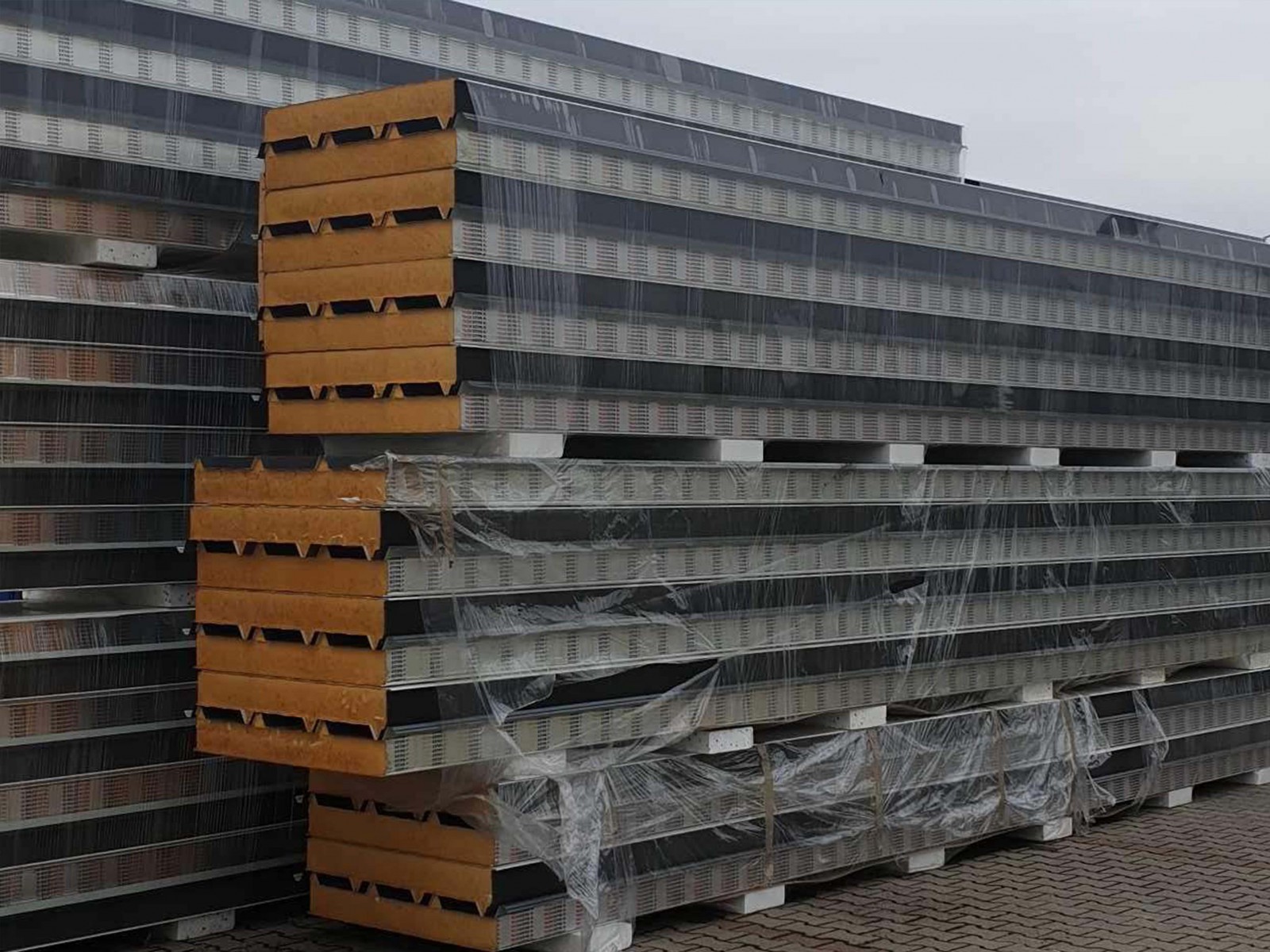
Sandwich Panels – The Future of the Construction Industry
Versatile Sandwich Panels
Sandwich panels, also known in Poland as Oborniki panels (named after the pioneering manufacturing plant in Oborniki), are prefabricated building elements consisting of two metal facings, usually made of steel, and an insulating core.
They have been used for decades in steel-frame construction. Sandwich panels are versatile building materials suitable for constructing both large industrial halls and smaller structures, such as kiosks, market stalls and commercial pavilions.
Their properties are particularly appreciated by investors who want to complete sports facilities, restaurants, service buildings and retail premises quickly.
Thanks to their thermal insulation properties, sandwich panels can be used to construct buildings intended for regular human occupancy, as well as cold storage facilities and freezers.
Sandwich panels can be used to construct external walls, roofs, internal partitions and other building envelope elements.
Partitions made from sandwich panels are generally designed as non-ventilated assemblies. Properly installed panels provide high airtightness and help limit uncontrolled air movement and moisture transfer through the building envelope.
Sandwich panels are self-supporting building components covered by the requirements of EN 14509.
They are designed to transfer their own weight and specified external loads, including wind pressure, wind suction and snow loads, to the supporting structure.
Their load-bearing performance depends on the panel design, the bond between the insulating core and metal facings, the span, and the fixing system.
What Types of Sandwich Panels Are Available?
Sandwich Panels with a Polyurethane (PIR) Core
Sandwich panels with a polyurethane-based core are manufactured using two profiled facings made from galvanised structural steel sheets.
The available surface profiles include:
- Fine profiling
- Linear, wavy and grooved embossing
- Micro-profiled surfaces
- Flat profiles
- Sinusoidal profiles
Trapezoidal profiling is typically used on the external facing of roof sandwich panels.
During production, polyisocyanurate (PIR) foam is introduced between the steel facings.
The foam expands rapidly, filling the space between the sheets. Its adhesive properties create a strong bond between the insulating core and the metal facings.
Panel joints and edges are designed to protect the insulating core against mechanical damage and weather exposure. Depending on the product, additional seals, tapes or protective elements may be used.
Sandwich Panels with an EPS Core
Manufacturers also offer sandwich panels with an expanded polystyrene (EPS) core.
These panels are produced by placing EPS insulation blocks between two profiled metal facings and bonding the components using a suitable polymer adhesive.
EPS-core sandwich panels may be susceptible to gaps or inconsistencies in the insulating core if the manufacturing process is not properly controlled.
However, reputable manufacturers use precise cutting and assembly methods to ensure that the EPS blocks fit closely together and maintain a consistent thickness.
Modern production facilities may also use specially shaped or interlocking EPS insulation elements.
These solutions help reduce gaps in the insulating core, limit thermal bridging and improve panel rigidity.
PIR-core sandwich panels generally provide better thermal insulation performance at the same thickness than comparable EPS-core panels.
Their manufacturing process also allows the insulating core to be formed continuously between the metal facings, helping achieve consistent insulation and mechanical properties.
Nevertheless, the actual quality and performance of both PIR and EPS sandwich panels depend on the manufacturer, production standards and product specifications.
High-quality products can be found in different price categories. Choosing the right panels requires familiarity with the market and practical experience to avoid offers that appear attractive but do not meet the project’s technical requirements.
Sandwich Panels with a Mineral Wool Core
In addition to EPS and PIR, the market offers sandwich panels with a mineral wool core, typically made from stone wool.
These panels combine good thermal insulation properties with the advantages of a non-combustible insulating material.
Mineral wool sandwich panels are particularly valued for their fire performance.
They are frequently used in buildings where fire safety regulations and technical requirements specify fire resistance classifications such as EI 30, EI 60, EI 90 or EI 120.
The actual fire resistance classification applies to a tested panel assembly and depends on factors such as panel thickness, joints, fixings and installation conditions.
High-quality EPS- and PUR/PIR-core sandwich panels may also have documented reaction-to-fire classifications and, in certain tested systems, fire resistance ratings.
However, these properties must always be verified using the manufacturer’s technical documentation and the relevant test certificates.
Quality and Price of Sandwich Panels
Manufacturing PIR-core sandwich panels requires modern, automated production lines.
This involves significant investment, not only in industrial machinery but also in production buildings, suitable flooring, safety systems and other infrastructure.
When comparing offers, it is worth remembering that particularly inexpensive sandwich panels may sometimes come from smaller manufacturing facilities with limited production capabilities.
In some cases, the main competitive advantage of these products is their low price rather than their technical performance.
Strong price competition can encourage cost-cutting measures, such as the use of lower-quality adhesives or less advanced manufacturing methods.
As a result, inexpensive sandwich panels of uncertain origin may not always provide the expected quality, durability or performance.
However, price alone is not a reliable indicator of product quality. The most important factors are verified technical parameters, manufacturing standards and suitability for the intended application.
If you are looking for affordable sandwich panels, an experienced technical adviser can help you compare products and select a solution that offers good value for money.
Sandwich Panels Available at ASPanel
Our ASPanel advisers will help you choose sandwich panels with the technical parameters best suited to your construction project.
We offer a wide selection of materials, including products available immediately from stock at our warehouses and distribution locations in:
- Miszewko
- Elbląg
- Słupsk
- Szczecin
Contact ASPanel to find the right sandwich panels for your project.