Frequently Asked Questions – Sandwich Panels
1. What Is a Sandwich Panel?
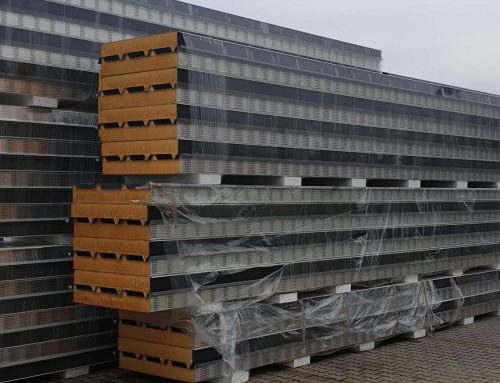
A sandwich panel is a prefabricated building material consisting of two outer facings, usually made of steel sheets, with a thermal insulation core between them. The core can be made from materials such as PIR foam or mineral wool.
Sandwich panels combine the functions of building cladding and thermal insulation, allowing walls and roofs to be constructed quickly without the need for multiple separate layers.
They are commonly used in the construction of industrial halls, warehouses, garages, workshops, industrial and agricultural buildings, commercial facilities and cold storage buildings.
Depending on their application, the two main types are wall sandwich panels and roof sandwich panels.
2. What Is a Sandwich Panel Made Of?
A typical sandwich panel consists of two steel sheet facings with an insulating core between them. All layers are bonded together to form a single prefabricated building component.
The most common core materials include:
- PIR – providing excellent thermal insulation performance at a relatively low thickness.
- Mineral wool – primarily selected where specific fire protection and acoustic insulation requirements must be met.
The external steel facings are available in various colours, protective coatings and surface profiles, allowing the panels to be matched to both the building’s intended use and its appearance.
3. What Sandwich Panel Thickness Should You Choose?
The thickness of a sandwich panel should be selected according to the building’s intended use, required thermal insulation performance, core material and whether the building will be heated. There is no single thickness suitable for every application.
In practice, thinner panels may be used in buildings with limited thermal insulation requirements, while heated buildings generally require thicker insulation.
When choosing a panel, consider:
- Building purpose
- Required indoor temperature
- Type of insulation core
- Thermal transmittance U-value
- Design requirements and applicable regulations
- Whether the panel will be installed on a wall or roof
Sandwich panels should not be selected based on thickness alone. Two panels of the same thickness but with different core materials or from different systems may have different thermal performance characteristics.
Indicative PIR Sandwich Panel Thickness Guide
| PIR Panel Thickness | Insulation Level | Typical Applications |
|---|---|---|
| 40 mm | Basic | Shelters, canopies, unheated garages and utility buildings |
| 60 mm | Basic / medium | Garages, warehouses and utility buildings with limited thermal insulation requirements |
| 80 mm | Good | Garages, workshops, warehouses and industrial halls, including intermittently heated buildings |
| 100 mm | High | Heated garages, workshops, warehouses and industrial halls |
| 120 mm | Very high | Heated buildings requiring high thermal insulation performance |
| 150 mm | Very high | Buildings with demanding energy efficiency requirements and specialised applications |
Important: This table is for general guidance only. Panel thickness alone does not determine whether a product is suitable for a particular building.
Before choosing a panel, check the U-value of the specific product, its core material, intended application (wall or roof), building usage, design specifications and applicable regulations.
4. What Sandwich Panel Thickness Is Best for a Garage?
The appropriate sandwich panel thickness for a garage depends primarily on whether the garage will be heated and the desired indoor temperature.
Thinner panels may be considered for unheated garages, while heated garages require better thermal insulation.
For garages built with PIR sandwich panels, commonly considered thicknesses include 40, 60, 80, 100 mm and above. However, this does not mean that every thickness is suitable for every garage.
| Garage Type | Main Selection Criteria |
|---|---|
| Unheated garage | Weather protection and cost |
| Intermittently heated garage | Balance between price and thermal insulation |
| Year-round heated garage | Suitably low U-value |
| Garage attached to a house | Design requirements and applicable regulations |
If the garage is intended to be heated throughout the year, panel thickness should be determined by the required thermal performance of the building envelope rather than simply choosing a commonly used thickness.
5. Which Sandwich Panel Is Best for a Heated Garage?
For a heated garage, it is worth choosing a sandwich panel with good thermal insulation properties, such as a PIR-core panel, and selecting its thickness according to the required U-value.
The lower the U-value of a building element, the less heat it loses.
For this reason, thicker panels are generally worth considering for heated garages than for basic unheated garages.
Correct installation of panel joints, corners, garage doors, flashings and other areas where thermal bridges may occur is equally important.
If the garage forms part of a residential building or is subject to specific energy efficiency requirements, the final selection should comply with the building design and current technical regulations.
6. Which Sandwich Panel Is Best for an Unheated Garage?
An unheated garage generally has lower thermal insulation requirements than a heated garage, so thinner sandwich panels may often be suitable.
However, this does not mean that the thinnest or cheapest panel is always the best option.
Consider whether the garage will only be used for parking a vehicle or whether it will also serve as a workshop, storage area or occasionally heated space.
If you plan to heat the garage in the future, choosing a panel with better thermal insulation performance during construction may be a more practical long-term solution.
7. What Sandwich Panel Thickness Should Be Used for an Industrial Hall?
There is no universal sandwich panel thickness suitable for every industrial hall. The correct choice depends primarily on the building’s purpose, required indoor temperature and the thermal performance of its walls and roof.
An unheated storage hall has different requirements from a heated production hall or a cold storage facility.
The most important factors to consider include:
- Intended use of the building
- Indoor temperature
- Heating system
- Required U-value
- Type of insulation core
- Application – wall or roof
- Fire safety requirements
- Building design and applicable technical regulations
For larger industrial buildings, panel thickness should therefore be determined primarily by the building design and the required performance of the building envelope.
8. Which Sandwich Panel Is Best for a Workshop?
When choosing sandwich panels for a workshop, both thermal insulation performance and the intended use of the premises should be considered.
If the workshop will be heated throughout the year, the thermal properties of its walls and roof become particularly important.
PIR-core sandwich panels are a popular solution for these buildings because they offer good thermal insulation performance with a relatively thin insulating core.
Before selecting a panel, determine:
- Whether the workshop will be heated
- The required indoor temperature in winter
- Whether high humidity levels are expected
- Fire safety requirements
- Whether special internal protective coatings are needed
- Requirements for walls and roofs
Workshops intended for specialised activities may be subject to additional requirements depending on their design and the type of work carried out.
9. Which Sandwich Panel Is Best for a Warehouse?
Sandwich panels for warehouses should be selected primarily according to the type of goods being stored and the temperature that must be maintained inside the building.
An unheated warehouse may have relatively limited thermal insulation requirements. However, if the warehouse is heated, the walls and roof must provide suitable thermal performance.
Facilities storing products that require controlled temperatures or specific hygiene conditions have additional requirements.
When choosing panels, consider not only their thickness but also:
Core material, U-value, facing type, protective coating, fire safety requirements and panel joint design.
10. Which Sandwich Panel Is Best for a Utility Building?
A utility building can be constructed using PIR-core sandwich panels or, depending on its requirements, mineral wool sandwich panels. The key factor is determining the building’s intended purpose and whether it will be heated.
A simple, unheated building used for equipment storage has different thermal insulation requirements from a heated workshop, an animal housing facility or a building used throughout the year.
For utility buildings, it is particularly important to consider:
- Indoor environmental conditions
- Potential moisture exposure
- Ventilation
- Thermal insulation requirements
- Type and durability of the steel sheet coating
- Fire safety requirements
The choice of sandwich panel should therefore be based on how the building will actually be used, rather than solely on the lowest price per m².