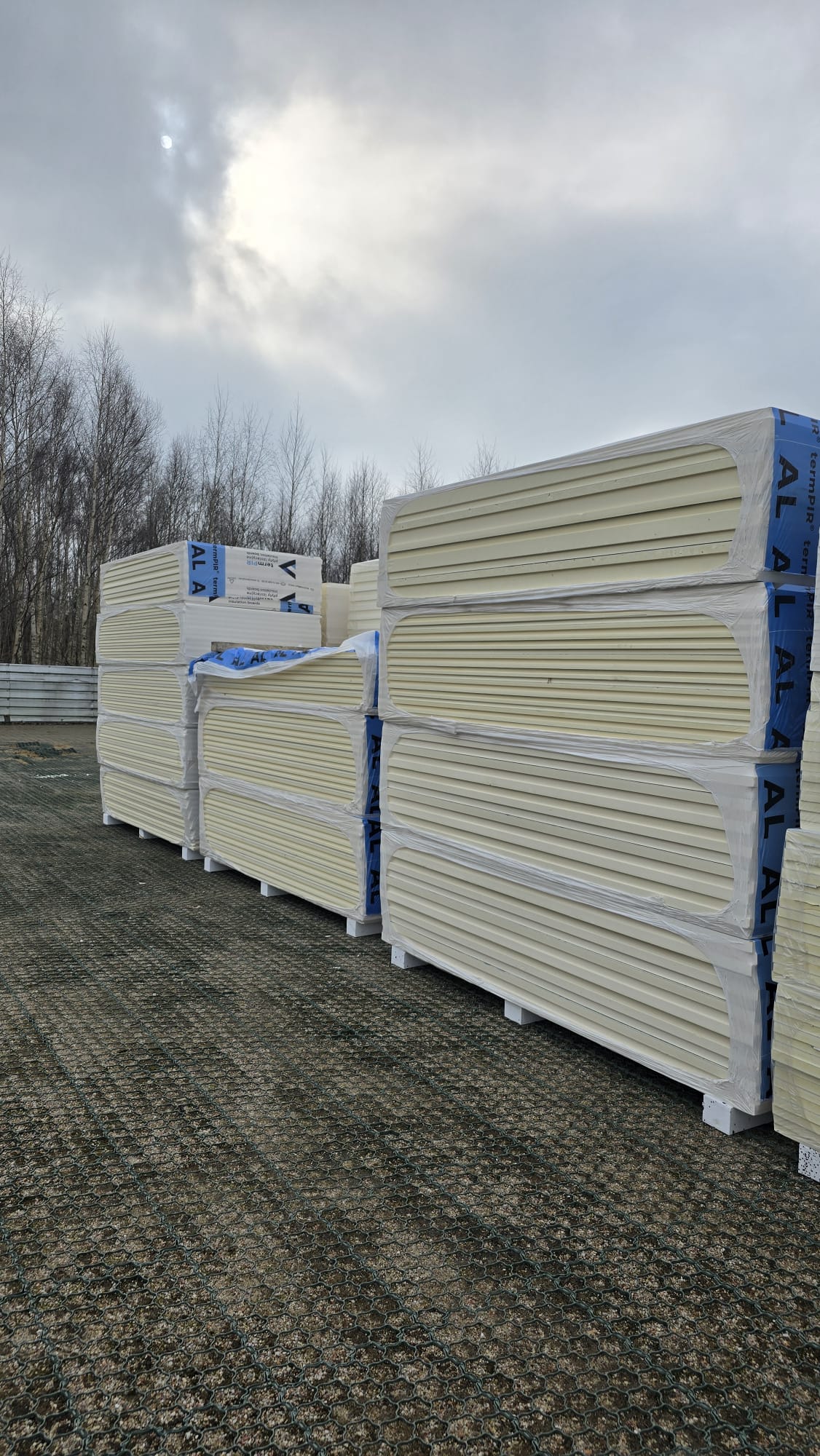
Polyurethane Insulation – PIR Boards and Their Applications
Different types of polyurethane are widely used in construction. Polyurethane insulation, particularly insulation boards made from this type of polymer, is used both for the thermal renovation of existing buildings and in the construction of new single-family and multi-family homes.
The wide range of applications of these polymers results from their excellent thermal insulation properties, good performance characteristics and various application and installation methods. This versatility makes it possible to meet a broad range of requirements for individual construction projects.
Particularly noteworthy are innovative solutions based on polyisocyanurate (PIR), which is used to manufacture insulation boards with certain performance advantages over conventional polyurethane (PUR) insulation.
Chemistry and Fire Resistance
As early as the 1950s, research into isocyanates demonstrated that, when suitable catalysts were used, they could form chemical structures with improved resistance to high temperatures compared with conventional polyurethane.
One of the main advantages of PIR foam over traditional PUR insulation is its improved fire performance, including a greater tendency to form a protective char layer when exposed to flames.
PIR insulation boards also offer increased resistance to elevated temperatures and good dimensional stability within their specified operating temperature range.
Compared with conventional PUR foam, PIR insulation has a greater ability to form a carbonised protective layer. This helps slow down the penetration of heat and flames into the insulation material.
These characteristics contributed to the development of PIR materials for demanding technical applications, including aerospace-related uses, from the 1970s onwards.
Today, PIR insulation boards such as Thermano, Izolate and termPIR are increasingly used in thermal insulation projects, replacing certain types of rigid PUR foam.
When exposed to fire, PIR materials generally exhibit better charring behaviour than conventional PUR foams. However, their reaction to fire, smoke production and possible melting or dripping depend on the specific product and its tested classification.
The suitability of PIR boards for fire-resistant building assemblies must always be confirmed by the relevant system testing and technical documentation. PIR boards should not automatically be treated as fire barriers.
PIR insulation boards can be an alternative to mineral wool in applications where high thermal efficiency and low weight are important, although their fire performance characteristics differ.
Another significant advantage is the relatively low weight of PIR insulation compared with many mineral-based insulation solutions.
PIR Board Facings and Edge Profiles
PIR foam is available in several forms, including the insulating cores of sandwich panels with rigid steel or aluminium facings, as well as insulation boards with flexible facings.
These facings may be manufactured from:
- Paper
- Aluminium foil
- Mineral fibre materials
- Composite laminates
- Glass fibre
- Bitumen-coated materials
Manufacturers also offer insulation boards with multilayer facings.
For example, Thermano PIR boards feature facings made from gas-tight polymer layers combined with aluminium foil.
To minimise gaps between adjacent insulation boards, manufacturers offer different edge profiles, including:
- Straight edges
- Rebated or stepped edges
- Tongue-and-groove joints
Appropriately selected edge profiles help improve installation accuracy and reduce the risk of thermal bridges.
From Basements to Roofs – Applications of PIR Insulation Boards
PIR insulation boards with flexible facings, like polyurethane insulation installed using other methods, have a wide range of applications.
They are commonly used to insulate flat and pitched roofs on residential buildings, as well as larger commercial and industrial properties.
The technical properties of the facings and insulating core make selected PIR board types suitable for insulating industrial facilities, commercial buildings, walls, floors and ceilings.
PIR Insulation for Pitched Roofs
PIR insulation boards, including Thermano and termPIR, can be installed on pitched roofs in several ways:
- Above the rafters
- Below the rafters
- Between the rafters
Above-rafter insulation is particularly effective when using rigid PIR boards, as it allows a continuous insulation layer to be created and significantly reduces thermal bridges caused by the roof structure.
PIR Insulation for Flat Roofs
The low weight and high compressive strength of suitable PIR boards make them useful in flat roof systems.
Depending on the product and approved roofing system, PIR insulation can be combined with bituminous roof coverings, PVC membranes or EPDM membranes.
These solutions can be installed on appropriately designed timber, concrete or steel roof structures.
The high compressive strength of PIR insulation boards is another important advantage.
Some PIR products offer significantly higher compressive strength than conventional EPS or mineral wool insulation boards, although the exact difference depends on the product grades being compared.
This property helps the insulation withstand loads during installation and subsequent roof maintenance, provided the complete roofing system is designed for the expected loads.
PIR Insulation for Walls, Foundations and Floors
PIR insulation boards can also be used in cavity walls and certain external wall insulation systems.
Boards with suitable mineral facings can provide improved adhesion for plaster and rendering systems designed for PIR insulation.
Manufacturers also offer PIR insulation solutions for foundation walls in both newly constructed and renovated buildings.
The low water absorption of PIR insulation helps limit moisture penetration into the insulation layer, contributing to the durability of the building envelope.
However, appropriate waterproofing and moisture protection are still essential, particularly in below-ground applications.
PIR boards can also be used to insulate:
- Internal partition walls
- Floors and ceilings
- Balconies
- Terraces
- Foundation walls
- Other building elements requiring effective thermal insulation
The selected board must be suitable for the specific application and installed in accordance with the manufacturer’s technical recommendations.
PIR Insulation Boards Available Immediately at ASPanel
If you would like to explore insulation products from different manufacturers, we invite you to visit ASPanel in Miszewko, Elbląg or Słupsk.
We offer a wide selection of PIR insulation boards available immediately from stock.
Our team will help you select the insulation solution best suited to your construction project and assist you in completing your order.
Experienced staff and a regularly stocked product range help customers begin construction work promptly and keep their projects on schedule.
Contact ASPanel today:
- Visit our locations in Miszewko, Elbląg / Słupsk or Szczecin
- Call us: +48 500 306 305
- Contact us through our website or social media channels
Choose high-performance PIR thermal insulation with ASPanel!