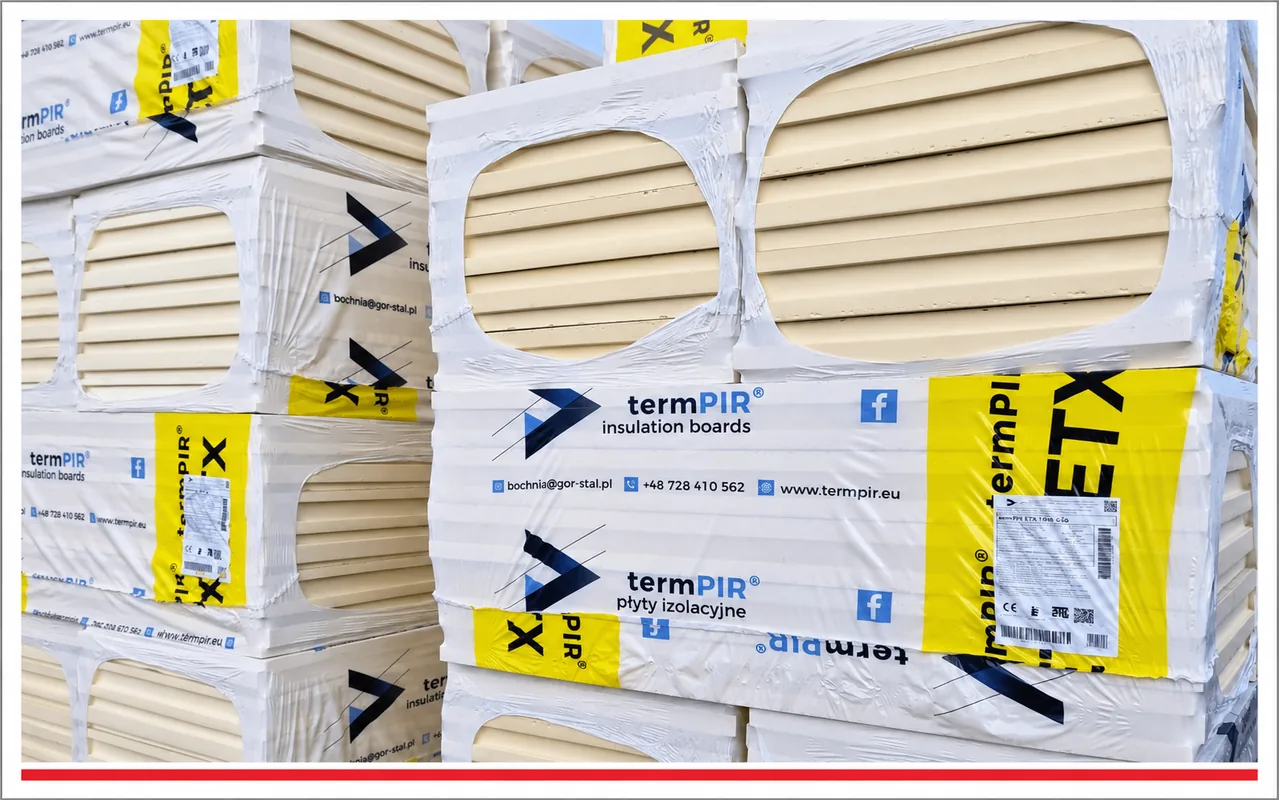
1. What is a PIR insulation board?
A PIR board (short for polyisocyanurate insulation board) is a modern, high-performance rigid thermal insulation board belonging to the closed-cell thermoset plastics family (a rigid polyurethane foam chemically modified with isocyanurate ring structures). It is currently the most thermally efficient mainstream insulation material used across residential, commercial, industrial, and agricultural construction.
Every PIR insulation board has a composite structure consisting of two main elements:
- A rigid closed-cell polyisocyanurate (PIR) foam core:
- Over 95% of the foam’s volume consists of microscopic, sealed cells filled with a low-conductivity blowing agent (typically pentane). The core density is typically approx. 30–35 kg/m³.
- Thanks to this closed-cell structure, the core is both lightweight and exceptionally rigid – it does not compress underfoot and offers high compressive strength (typically 120–150 kPa, equivalent to 12 to 15 tonnes of load per 1 m²!).
- Double-sided flexible facings (laminates):
- During continuous lamination on the production line, the PIR core is bonded on both sides to specialist facings that act as gas-tight vapour barriers, reflect radiant heat, or provide a key for adhesives and torch-on membranes. The most common facings include:
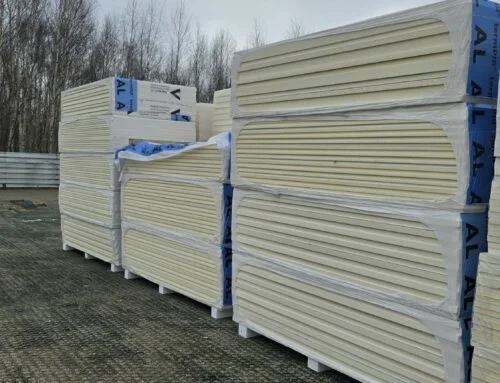
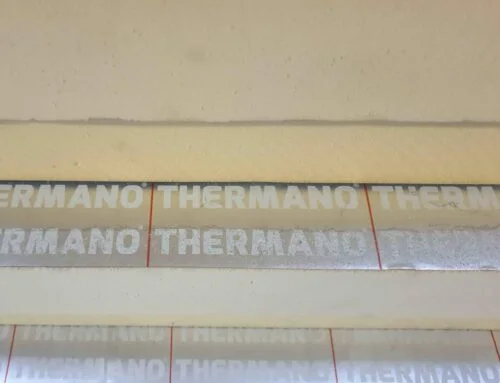
- Low-emissivity aluminium foil (AL – pure foil or kraft-backed aluminium laminate): a gas-tight facing that reflects radiant heat and delivers the lowest possible thermal conductivity (lambda 0.022 W/(m·K)).
- Coated glass tissue / Mineral glass fleece (CGT / MG) or bitumen-coated glass fleece: a textured mineral facing designed for bonding thin-coat render systems (EWI / ETICS), adhesive mortars, or torch-on bituminous roofing felt.
- Insulated plasterboard (thermal laminate): PIR boards factory-bonded directly to tapered-edge plasterboard for rapid internal dry-lining of walls and pitched roofs.
- During continuous lamination on the production line, the PIR core is bonded on both sides to specialist facings that act as gas-tight vapour barriers, reflect radiant heat, or provide a key for adhesives and torch-on membranes. The most common facings include:
The edges of PIR boards are available either square-edged or tongue-and-groove (T&G) / shiplap rebated, allowing boards to interlock into a continuous thermal envelope free from linear thermal bridging.
2. What is the difference between PIR and PUR?
Although both foams belong to the polyurethane chemical family and are produced by reacting two primary liquid components – polyol and isocyanate (MDI) – they differ in chemical ratio (the isocyanate index), molecular bond structure, and fire performance:
| Property | PUR Foam (Conventional Polyurethane) | PIR Foam (Polyisocyanurate) |
|---|---|---|
| Chemical formulation (MDI to polyol ratio) | Near-balanced stoichiometric ratio (approx. 100 : 100). Forms primarily linear urethane linkages. | High excess of MDI isocyanate relative to polyol (e.g. 250 : 100) in the presence of catalysts. Three MDI molecules link together (trimerisation) to form isocyanurate rings. |
| High-temperature resistance | Linear urethane bonds in PUR begin to break down at around 200°C. | The cyclic isocyanurate rings in PIR are chemically much stronger – withstanding temperatures up to 300–350°C before decomposition. |
| Fire behaviour | Lower – PUR degrades more rapidly under intense heat and produces more smoke (typically reaction-to-fire class E, D, or C). | Superior – when exposed to flame, the surface of a PIR board rapidly chars (forming a rigid carbonaceous crust) that starves the underlying core of oxygen and protects it against further combustion (achieving classes B-s1, d0, B-s2, d0, or C-s2, d0 depending on facing). |
| Mechanical rigidity & dimensional stability | More flexible (today used mainly as open- or closed-cell liquid spray foam and canned expanding gap-filling foam). | Significantly stiffer, harder, and more dimensionally stable – which is why virtually all factory-made rigid insulation boards and composite sandwich panels today use PIR rather than PUR. |
In short: PIR is the advanced, next-generation evolution of polyurethane, engineered to retain the outstanding thermal efficiency of PUR while dramatically improving fire resistance, temperature tolerance, and compressive strength.
3. What are PIR insulation boards used for?
PIR boards are specified wherever builders, architects, and homeowners need maximum thermal insulation with the slimmest possible profile. Their main applications include:
- Pitched roof insulation (loft conversions and habitable roofs):
- Over-rafter insulation (sarking / warm pitched roof): Technically the most effective way to insulate a roof – tongue-and-groove PIR boards are laid in a continuous layer over the timber rafters (eliminating thermal bridging through the timber rafters), preserving full headroom inside the loft and leaving the timber rafters exposed as an interior feature if desired.
- Between- and under-rafter insulation: Slim PIR boards (e.g. 50–80 mm) fixed beneath the rafters cut out thermal bridging through the roof timbers and act as a continuous vapour control layer.
- Flat roof insulation (warm flat roofs on concrete or metal decks):
- Thanks to their high compressive strength (120–150 kPa), PIR flat roof boards easily support maintenance foot traffic and solar PV arrays without crushing. Single-ply membranes (PVC/TPO/EPDM) or torch-on felt (on bitumen/glass-tissue-faced boards) are laid directly on top. Tapered PIR roof boards (factory-cut to a 1:60 or 1:80 fall) are also widely used to insulate a flat roof and create drainage falls toward rainwater outlets simultaneously.
- Solid concrete and suspended ground floors (especially underfloor heating):
- Where floor build-up height is restricted (e.g. by door thresholds or ceiling height), an 80–100 mm PIR board replaces 150–180 mm of expanded polystyrene (EPS), offers superior compressive resistance under screed, and features a foil facing that reflects radiant heat upwards from underfloor heating pipes.
- Cavity walls, external walls, and internal dry-lining:
- Used as full-fill or partial-fill masonry cavity wall boards, rainscreen facade insulation, and internal wall insulation (using PIR-backed insulated plasterboard on refurbishment projects).
- Basements, plinths, agricultural buildings, and cold stores:
- In poultry houses, livestock buildings, and crop stores, foil-faced PIR boards form washable, vermin-resistant suspended ceilings that withstand high-pressure cleaning.
4. Is PIR better than polystyrene (EPS)?
In terms of physical and thermal performance, PIR insulation boards outperform expanded polystyrene (EPS) across almost every engineering metric, while the primary advantage of EPS is its lower purchase cost per cubic metre:
| Technical Parameter | PIR Board (foil-faced) | White EPS (Expanded Polystyrene) | Grey / Graphite EPS |
|---|---|---|---|
| Thermal conductivity (lambda λ) | 0.022 W/(m·K) (market-leading!). | 0.038 – 0.040 W/(m·K) | 0.031 – 0.033 W/(m·K) |
| Thickness required for Roof U = 0.15 W/(m²·K) | only 140 – 150 mm | 250 – 270 mm | 200 – 220 mm |
| Thickness required for Wall U = 0.20 W/(m²·K) | only 100 – 110 mm | 180 – 200 mm | 150 – 160 mm |
| Compressive strength at 10% compression | 120 – 150 kPa (12–15 tonnes/m² as standard!). | 60 – 80 kPa (wall) / 100 kPa (floor). | 70 – 80 kPa (sensitive to direct sunlight during installation!). |
| High-temperature & fire resistance | Thermoset (up to +200°C / +300°C). Chars on exposure to flame; does not melt or produce flaming droplets. | Thermoplastic (up to +80°C only!). Softens, shrinks, and melts above 85°C (e.g. under dark metal roofing in summer!). | Highly sensitive to solar overheating on site (bows if left unshaded on facades). |
| Resistance to solvents & rodents | High – rodents are far less likely to nest in rigid PIR; completely resistant to organic solvents, adhesives, and petrol. | Low – mice and martens readily burrow into EPS; organic solvents and solvent-based paints dissolve polystyrene instantly. | Low – same as white EPS. |
Conclusion: A PIR board is approx. 40–45% more thermally efficient than white EPS and approx. 30% more efficient than graphite EPS. Choose PIR whenever slim constructions matter (maximising room space, window reveal light, or floor-to-ceiling height), under metal roofs that get hot in summer, on flat roofs, or under floor screeds. Choose EPS when insulating simple external masonry walls with no space restrictions on a tight budget.
5. Is PIR better than mineral wool?
Comparing PIR boards with mineral wool (stone wool or glass mineral wool) has no single overall winner – each material excels in different areas of building physics (and they are often combined in hybrid roof designs):
Where PIR boards outperform mineral wool:
- Thermal efficiency (slimmer build-up): PIR (lambda 0.022) insulates nearly twice as effectively as typical mineral wool (lambda 0.035–0.039). To achieve the same roof U-value, 150–160 mm of PIR replaces 280–300 mm of mineral wool.
- Complete moisture resistance: If a roof tile cracks or an internal vapour membrane is poorly taped, mineral wool can soak up water like a sponge, losing its thermal performance and sagging. Closed-cell PIR does not absorb water and acts as its own vapour barrier.
- Elimination of thermal bridging (over-rafter installation): Interlocking tongue-and-groove PIR boards laid over the rafters create an unbroken thermal blanket, whereas mineral wool fitted between rafters is interrupted every 40–60 cm by timber rafters (which conduct heat four times faster than the insulation).
- Low weight and itch-free handling: PIR boards are lightweight (30 kg/m³) and do not shed irritating fibrous dust when cut.
Where mineral wool outperforms PIR boards:
- Acoustic insulation (soundproofing): Rigid, lightweight PIR boards offer modest airborne sound reduction (e.g. rain drumming on metal roofs or street traffic). Dense, fibrous mineral wool absorbs sound waves exceptionally well.
- Non-combustibility (Reaction-to-fire Class A1 / A2): Mineral wool is spun from volcanic basalt rock or glass and is 100% non-combustible (melting above 1000°C). PIR is a flame-retardant, charring thermoset polymer (Class B to E depending on facing), but remains an organic material.
- Breathability (vapour permeability) and flexibility: Flexible mineral wool batts compress snugly between uneven, historic timber rafters and allow water vapour to diffuse through, whereas rigid PIR boards require straight timbers and low-expansion foam sealing at joints.
The hybrid best-practice solution: On habitable pitched roofs (especially under metal roofs), architects frequently combine both: PIR boards over or under the rafters (for maximum thermal efficiency and airtightness) paired with acoustic mineral wool between the rafters (for peace and quiet during heavy rain).
6. What lambda (thermal conductivity) value do PIR boards have?
The declared thermal conductivity (lambda, λD – which already includes a mandatory 25-year thermal ageing allowance) of PIR insulation boards ranges from 0.020 to 0.028 W/(m·K).
The exact lambda value of a specific PIR board depends directly on the type of facing laminated to the foam core (and on board thickness):
- PIR boards with gas-tight facings (pure aluminium foil AL, or multi-layer metallised kraft-aluminium laminates):
- Lambda = 0.022 W/(m·K) (and down to 0.020 – 0.021 W/(m·K) in next-generation formulations) – across all board thicknesses!
- Why does aluminium foil give a lower lambda? During foaming, the microscopic PIR cells are filled with an insulating blowing gas (pentane) that conducts far less heat than air. Gas-tight aluminium facings on both sides act as a hermetic seal – locking the insulating gas inside the cells for decades and preventing atmospheric air from diffusing in.
- PIR boards with gas-permeable facings (coated glass tissue CGT, mineral fleece, bitumen-coated glass fleece):
- Because glass fibre tissue is not completely gas-tight, a small proportion of the blowing gas in the outer millimetres of the board slowly exchanges with air over the first few years until equilibrium is reached. Consequently, the declared aged lambda depends on board thickness:
- Boards thinner than 80 mm: lambda = 0.026 – 0.027 W/(m·K)
- Medium boards (80 mm – 119 mm): lambda = 0.025 – 0.026 W/(m·K)
- Thick boards (120 mm and above): lambda = 0.024 – 0.025 W/(m·K)
- Because glass fibre tissue is not completely gas-tight, a small proportion of the blowing gas in the outer millimetres of the board slowly exchanges with air over the first few years until equilibrium is reached. Consequently, the declared aged lambda depends on board thickness:
Even with a glass tissue facing (0.025), PIR remains significantly warmer than the best graphite polystyrene (0.031) and mineral wool (0.035).
7. Are PIR boards moisture-resistant?
Yes, PIR insulation boards exhibit exceptionally high resistance to liquid water, damp, and water vapour.
This is due to their microscopic cell structure and chemical composition:
- Closed-cell structure (over 95% closed pores):
- Unlike fibrous insulation materials, PIR foam consists of millions of discrete, sealed microscopic cells with rigid polymer walls. Water cannot travel from cell to cell – PIR boards are completely non-capillary and do not wick water.
- Minimal water absorption under long-term immersion:
- In laboratory tests involving total immersion underwater for 28 days, water absorption in PIR boards is just 1% to a maximum of 2% by volume (water only enters the microscopic surface cells cut open by the saw blade along the perimeter edges).
- High water vapour diffusion resistance (μ-value):
- The PIR foam core itself has a high vapour resistance factor (μ=50–100), while a foil-faced PIR board is virtually vapour-proof (μ>50,000–100,000). Once the joints between foil-faced PIR boards are sealed with aluminium foil tape, the insulation layer acts simultaneously as a complete Vapour Control Layer (VCL) without needing a separate polythene sheet.
- Biological immunity:
- PIR foam is biologically inert – even in damp environments (basements, perimeter foundations, agricultural sheds), it does not rot, decay, or support mould or fungal growth.
8. Is PIR a combustible (flammable) material?
PIR is NOT an easily ignitable or self-sustaining flammable material – it is a FLAME-RETARDANT, self-extinguishing thermoset material that chars on exposure to fire and never produces flaming droplets.
To understand how PIR behaves in a fire, it is important to look at standardised fire engineering principles:
- Why isn’t PIR classified as Class A1/A2 (like stone or mineral wool)?
- Fire classes A1 and A2 are reserved strictly for inorganic mineral materials (concrete, steel, glass, stone wool). Because PIR is a carbon-based organic polymer, it falls within Reaction-to-Fire classes B to E (depending on its facings and end-use assembly).
- How does a PIR board behave in a fire? (The charring mechanism):
- When intense flame hits a PIR board, its strong isocyanurate ring structure does not melt or soften (unlike thermoplastic polystyrene EPS, which melts into a liquid above 100°C and disappears from the cavity).
- Instead, the outer few millimetres of the PIR foam undergo rapid charring – forming a rigid, porous graphite-like carbon crust. This black char layer acts as a natural heat shield: it blocks oxygen from reaching the deeper foam core and prevents flames from penetrating through the board.
- Once the external flame source is removed, PIR self-extinguishes immediately.
- Reaction-to-fire ratings of PIR boards:
- B-s1, d0 / B-s2, d0 (achieved by steel-faced PIR composite panels and specialist foil- or glass-tissue-faced PIR boards): very limited contribution to fire, low smoke emission (s1/s2), and zero flaming droplets (d0) – nothing melts or drips from a PIR-insulated ceiling onto escaping occupants or firefighters!
- C-s2, d0 / D-s2, d0 / E: standard PIR boards tested naked before being covered by internal linings (such as plasterboard, floor screed, or render). Once lined with plasterboard, a PIR-insulated wall or roof assembly readily achieves 30 to 60 minutes of fire resistance (REI 30 / REI 60).
9. What is the lifespan of PIR insulation boards?
The service life of PIR insulation boards matches the design life of the building itself – at least 50 to 60+ years.
The long-term durability of PIR boards is backed by decades of testing and real-world monitoring:
- Zero slumping, sagging, or settlement over half a century:
- Soft, low-density fibrous insulation mats installed in pitched roofs or timber-frame walls can settle by several centimetres over 15–20 years, opening up uninsulated cold gaps at the top of walls or ridges.
- A PIR board has a rigid cross-linked polymer matrix with a compressive strength of 120–150 kPa – it never sags, slumps, shrinks, or loses thickness under its own weight or under concrete floor screeds over the life of the building.
- Do PIR boards lose their thermal insulation value over time?
- No more than is already accounted for on the product label! Manufacturers are legally prohibited from printing the “fresh off the line” lambda value (approx. 0.018–0.019 W/(m·K)) on product declarations. Every board must undergo mandatory accelerated thermal ageing in a laboratory (simulating 25 years of in-situ service), and only this stabilised aged figure is declared as λD (e.g. 0.022 W/(m·K)). Once that diffusion equilibrium is reached, the board’s thermal performance remains stable for decades.
- Resistance to chemical and thermal ageing:
- PIR boards are immune to biological decay and withstand continuous operating temperatures from -50°C to +110°C as well as freeze-thaw cycling. Field studies of polyurethane/PIR roof boards excavated from flat roofs in Germany and Belgium after 35–40 years of service confirmed full retention of compressive strength and thermal resistance.
10. Are PIR insulation boards safe for human health?
Yes, factory-manufactured PIR insulation boards are 100% safe for human and animal health, chemically inert, fibre-free, and fully approved for use inside residential living spaces (including bedrooms, nurseries, and allergy-sensitive homes) as well as food storage facilities.
This is confirmed by chemical testing and indoor air quality certifications:
- Chemical curing is 100% completed in the factory (ultra-low VOC emissions):
- It is important not to confuse liquid two-component spray foam mixed on site (where a chemical reaction takes place inside the building and requires 24–48 hours of ventilation) with factory-made PIR boards.
- In a PIR board plant, polymerisation takes place at controlled high temperatures on the laminator, followed by curing in conditioning chambers. By the time a PIR board leaves the factory, it is a fully cured, chemically inert solid polymer.
- Independent Volatile Organic Compound (VOC) emission tests award PIR boards the highest European indoor air quality rating of Eurofins Indoor Air Comfort / Class A+ (ultra-low emissions).
- Free from formaldehyde, free isocyanates, and ozone-depleting gases (CFC / HCFC-free):
- Cured PIR boards release no free isocyanates and contain zero formaldehyde binders. Modern PIR boards are blown using ozone-friendly hydrocarbons (pentane) with zero Ozone Depletion Potential (ODP = 0) and free from CFCs and HCFCs.
- No irritating fibres when cutting or handling:
- Cutting and installing PIR boards releases no sharp glass or stone micro-fibres that irritate skin, eyes, or airways. The small amount of dust generated when sawing a PIR board is mechanically inert (requiring only a standard dust mask, just like sawing timber).
- Hypoallergenic and mould-free indoor environment:
- Because PIR boards do not absorb moisture, roofs and walls insulated with PIR resist dampness and prevent the growth of toxic black mould spores – one of the leading triggers of respiratory allergies and asthma in poorly insulated buildings.